
A furnace is worth replacing when the heat exchanger is cracked, when a major repair costs a big share of a new unit on an old furnace, or when it's past its service life and failing again and again. And furnaces last longer than most people are told. The Department of Energy puts the average life of a gas furnace at about 21.5 years.
That number matters.
A fifteen year old furnace with one failed part is usually a repair, not a replacement. Which part failed, and what it costs, is what decides it.
When is a furnace worth replacing rather than repairing?
Replace it when the heat exchanger is cracked, because a crack can let carbon monoxide into the house and nobody patches one. Replace it when a quote for a major part is a large fraction of a new system on a furnace that's already past twenty years. Otherwise, repair it. A single failed part on a furnace in its teens is usually worth fixing.
Here are four things that should push you toward replacing.
A cracked heat exchanger. Nobody patches one. It gets replaced, or the furnace does, and on an old furnace it's usually the furnace.
Repeated failures. Three service calls in two winters is a furnace trying to tell you something.
Age plus an expensive part. A control board or blower motor on a twenty-two year old furnace is money spent on something that's near the end anyway.
You're already doing the air conditioner. Replacing both together usually costs less than two separate jobs, because the labor overlaps and the system ends up matched. If the air conditioner is sound and has years left in it, that's a different call.
And one thing that shouldn't: a tune-up that turns into a sales pitch.
If a technician you called out for a service tells you the furnace needs replacing, get a second opinion before you agree. That's not being cynical. It's just how you buy something expensive.
What size furnace do I need?
It should be sized by a heat loss calculation on your actual house, not by the size of the old one and not by square footage alone. A proper calculation looks at insulation, windows, air leakage, ceiling height and which way the house faces. Anyone quoting a size after a quick look around without measuring anything is guessing. Ask how they arrived at the number.
Oversizing is the common mistake. Here's why it's a problem.
An oversized furnace heats the house fast, hits the thermostat setting and shuts off. Then the house cools, and it starts up again. That's short cycling. It means uneven temperatures, more wear on the ignition parts and worse humidity control.
People oversize because the old furnace was oversized, and because bigger feels safer.
If every quote you get names the same size and one names a bigger one, ask that contractor to show you the calculation.
What efficiency should I buy in Indiana?
Federal rules set the minimum at 80% AFUE for most new gas furnaces. ENERGY STAR requires 97% or better in northern states, and that includes Indiana. AFUE is simply the share of the fuel that turns into heat in your house instead of going up the flue. So a 97% furnace wastes three cents of every dollar of gas, and an 80% furnace wastes twenty.
Is the higher number worth the higher price? That comes down to one thing more than anything else: how long you're staying.
A 2012 Department of Energy guideline puts the payback on going from a 78% furnace to a 90% one at around nine years, for a home spending $1,000 a year on heat. The install costs behind it are from 2010, so take it as the shape of the answer. Fort Wayne winters are long enough that the math works better here than down south, but nine years is still nine years.
If you plan to stay a long time, the higher efficiency is more likely to pay back, and a condensing furnace at 95% or above is what usually goes in around here.
If you might move in a few years, the efficiency upgrade mostly benefits the next owner.
One practical note. Condensing furnaces produce acidic condensate and need a drain, and they vent through plastic pipe instead of the old chimney. If your house has never had one, that changes the installation, so make sure your quotes cover it. You don't want to find out on install day.
What the job involves
A straightforward furnace swap is usually a day's work for two people. The old furnace comes out and the new one goes in. The gas and electrical connections get made, the venting gets hooked up, the condensate drain gets run if it's a condensing unit, and the system is commissioned and tested before the crew leaves.
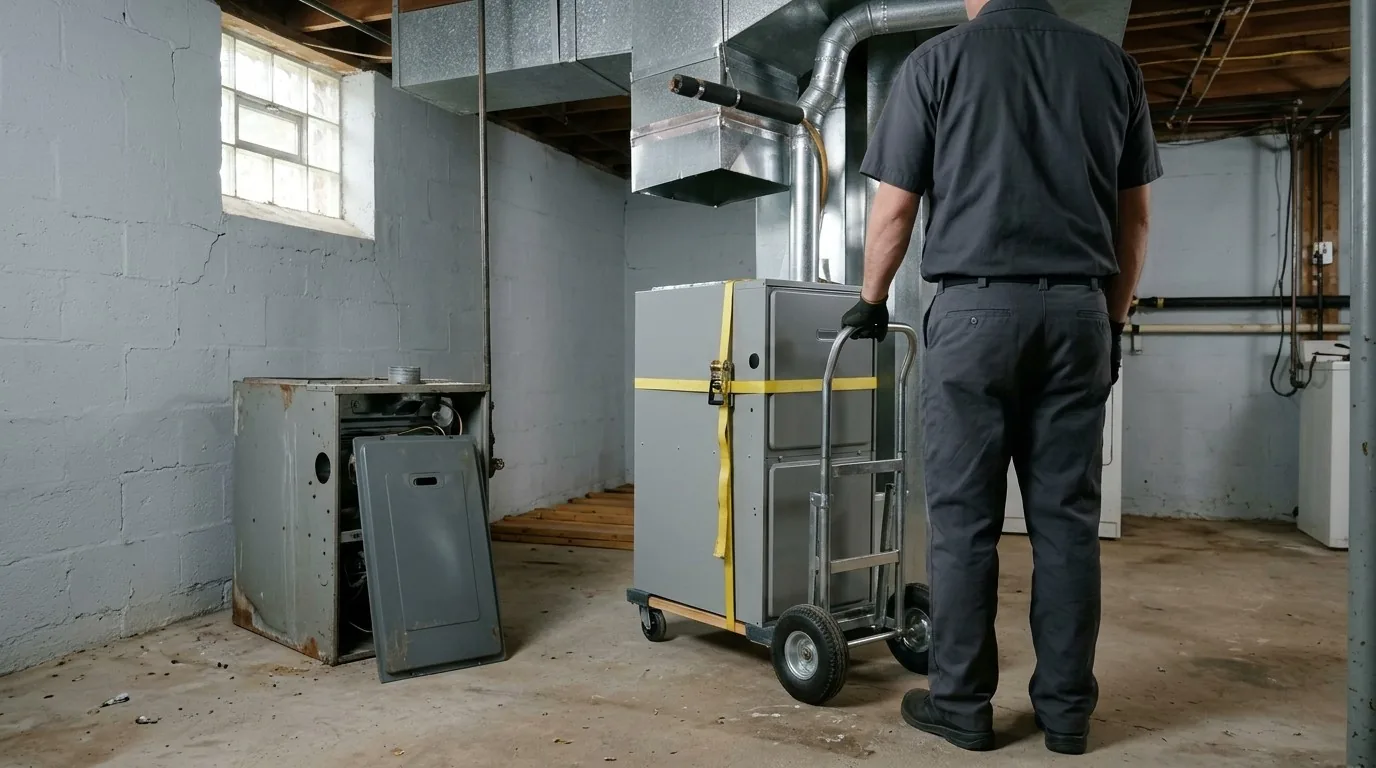
Commissioning is what separates a good installation from a bad one.
That means gas pressure set to the manufacturer's spec. Airflow measured, and the blower set correctly for your ductwork. Combustion tested with an analyzer. Safety controls checked. A furnace installed without all that is just a box that makes heat, and it won't perform the way the sticker says.
A heating permit is required in Allen County, and the rules require it to go to a contractor holding a current county license. If one quote is noticeably cheaper and doesn't mention a permit, ask about it directly.
What moves the price
Four things, and only one of them is the furnace itself: the efficiency and size you choose, whether the venting has to change, whether the ductwork needs work, and whether you do the air conditioner at the same time. The venting is the one that isn't obvious from the price of the furnace, and it usually comes up when you move up to a condensing unit.
Efficiency and size. A 95% condensing unit costs more than an 80% one, and the venting work that goes with it costs more too.
Whether the venting changes. Going from a chimney-vented furnace to a condensing one means new plastic venting through a wall, plus a condensate drain.
Ductwork. If the ducts are undersized or leaky, a new furnace won't fix that, and a good contractor will tell you so. It can turn a one day job into a bigger project.
Doing the air conditioner at the same time. It's more money up front, but usually less than doing them separately a few years apart, and the two end up properly matched. Worth it if the air conditioner is near the end anyway, not if it has years left.
What furnace repair and replacement cost here goes through the ranges.
Questions people ask
How long does a furnace replacement take?
Usually one day for a straight swap, with two people on site for most of it. It takes longer if the venting has to change, if the ductwork needs work, or if the furnace is somewhere awkward like a tight crawlspace.
You'll be without heat during the day, which is a good reason to do it outside the coldest weeks. Ask for the expected finish time when you book, not on the morning of.
Should a 20 year old furnace be replaced?
Not automatically. The Department of Energy's average life for a gas furnace is about 21.5 years, so twenty is old but not finished.
If it's running reliably, passing its combustion and heat exchanger checks, and hasn't needed repairs, keep it and put the money aside. If it's failed twice recently or needs an expensive part, that's a different answer.
Age alone isn't a reason.
Do I need a permit to replace a furnace in Fort Wayne?
Yes. Allen County rules require a heating permit to be issued to a contractor holding a current county license. That's part of why the license matters: an installer without one can't pull the permit.
Ask whether the permit is included in the quote. A contractor who suggests skipping it is asking you to carry a risk that isn't yours to carry.
Which brand of furnace is the most reliable?
Honestly, the installation matters more than the badge. The major brands share components, and the differences between them are smaller than the difference between a careful installation and a rushed one. A well-installed mid-range furnace will usually outlast a premium one that was oversized and never properly commissioned.
Pick the contractor first, then ask which brand they install most and are most used to servicing, because that's the one they'll have parts for.
Do I need to be home for the installation?
Yes, at least at the start and the end. Someone needs to let the crew in, show them where everything is, and be there at the end for the walkthrough on the new thermostat and the commissioning results.
Ask for the combustion readings and the airflow settings in writing. If anything goes wrong in the first winter, those numbers are what a second opinion will want to see.
Sources
Last updated