
Before anything else: heat is dangerous to older people, babies, anyone pregnant and anyone with a heart or lung condition. If someone is confused, slurring their words, faint or having a seizure, that's heat stroke, and it's a 911 call rather than a repair call. The CDC lists hot dry skin or heavy sweating among the signs, so don't wait for someone to stop sweating before you treat it as serious. Get them somewhere cool and start cooling them with water and wet cloths while help is on the way.
On an ordinary hot afternoon with a dead air conditioner, there are a few things you can safely check before you call.
None of them need you to open anything up.
What to check in the next five minutes
Check the thermostat, the filter and the outdoor unit, from where you're standing. Make sure the thermostat is set to cool and below room temperature. A clogged filter is the one thing on this list you can fix yourself. An outdoor fan that won't turn while the thermostat is calling for cooling is an electrical or mechanical problem and needs a technician. If the refrigerant line is iced up, switch cooling off and let it thaw.
Then these three, in order.
The filter. Pull it out and look at it. Gray and matted means replace it, and the denser high-efficiency ones won't pass light even when they're clean. Restricted airflow is one of the things that freezes a coil, and a frozen coil blows nothing at all. If there's ice already, leave cooling off rather than restarting it.
The outdoor unit. Look and listen from a few feet away. It should be running, with the fan turning and warm air coming off the top. Silent is one problem. Humming with the fan not turning is another, and that can be a capacitor, a fan motor or something electrical, so switch cooling off and call someone. Clear loose grass clippings and cottonwood from around the cabinet, but don't open it.
Ice. A frosted or iced refrigerant line usually means the coil has frozen. Switch cooling off at the thermostat. If the indoor fan is running normally, leaving it on helps it thaw, and that takes hours rather than minutes. Don't put cooling back on while there's still ice, and get the cause found before you go back to normal running.
What about the breaker?
If the breaker for the outdoor unit has tripped, you can reset it once. If it trips again, leave it off and get someone out. A breaker that keeps tripping is a problem, not an inconvenience.
When is it genuinely an emergency?
When the heat indoors is becoming a health risk, when the house keeps getting hotter instead of holding, or when the system is doing something that'll damage itself if it keeps running. Healthy adults get heat illness too, so don't read this as a rule where only vulnerable people count. If you can't keep the house at a safe temperature, go somewhere air conditioned rather than wait out a repair.
Don't wait for business hours on any of these. Some of them are a 911 call rather than a repair call.
- Someone vulnerable is home. Anyone elderly, very young, pregnant, or with a heart or lung condition
- It's still climbing. The house keeps getting hotter and you can't bring it down. Don't wait for a particular number on the thermostat before moving somewhere cooler
- Something smells burnt. Switch it off. If you can see smoke or flame, get out of the house and call 911
- The breaker won't stay on. Leave it off after the second trip and get it looked at. Don't keep resetting it
- Water's getting out. Water is coming from the indoor unit onto a ceiling or floor
Don't brush off that last one.
A blocked condensate drain can put water through a ceiling, and the water damage ends up costing more than the air conditioning repair.
How to stay cool and safe while you wait
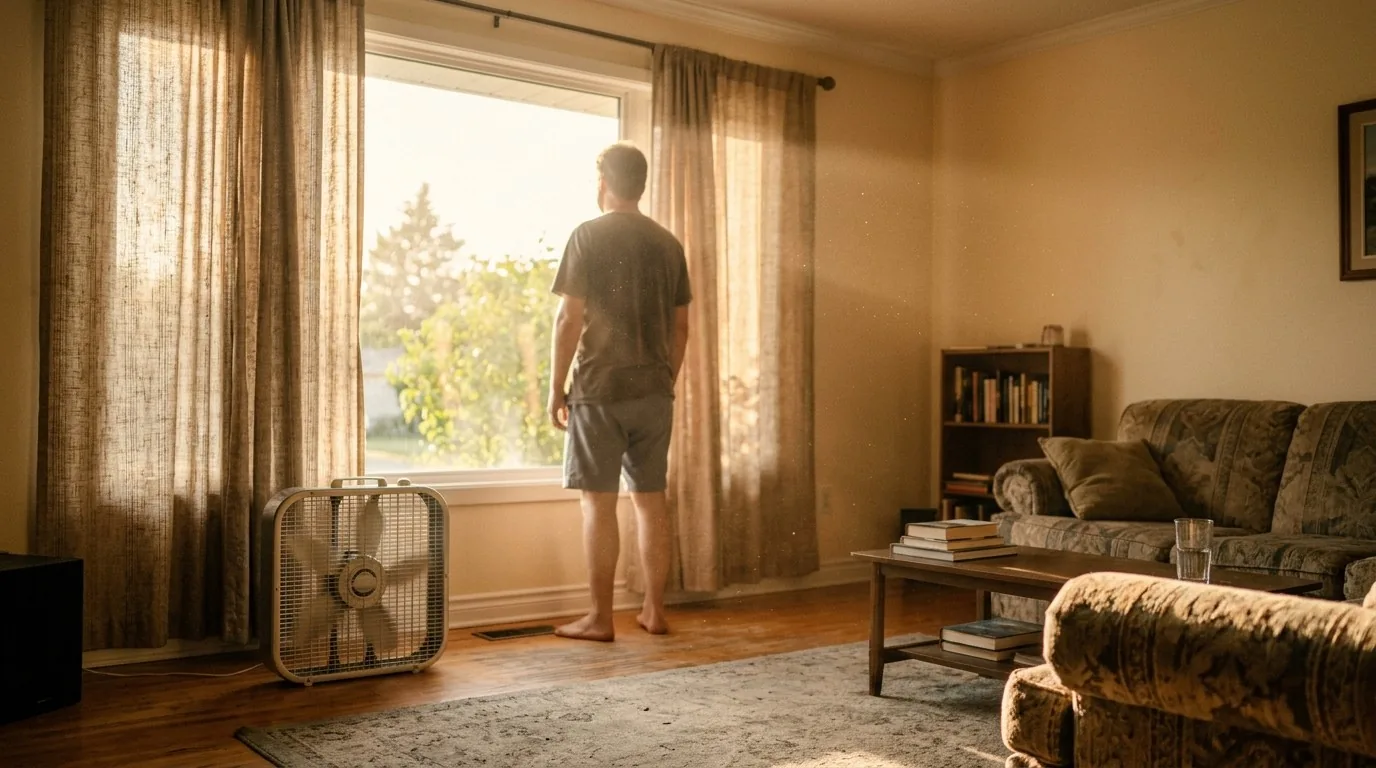
Close the blinds and curtains on the sunny side. Drink more water than you think you need, and a cool shower helps. Move everyone to the lowest floor, since heat rises, and don't use the oven. Fans only help below 90 degrees indoors. The CDC says that above that a fan can raise body temperature instead of lowering it, so check a thermometer before you rely on one.
There's one thing people reach for every summer, so here it is plainly.
Never run a generator or a grill indoors, in a garage, or near an open window.
A portable generator gives off carbon monoxide, and you can't see it or smell it. Keep it outside, at least 20 feet from doors, windows and vents, with the exhaust pointed away from the house. The CDC lists the symptoms as headache, dizziness, weakness, upset stomach, vomiting, chest pain and confusion. It also notes that someone who's asleep can be poisoned before feeling any of them.
If a carbon monoxide alarm goes off, get everyone outside and call 911 from there.
Is the house not holding a safe temperature, and nobody can get to you tonight? Then going somewhere air conditioned for the evening is a reasonable answer. A library, a mall or a relative's house beats sitting it out with someone vulnerable.
What emergency work costs
After-hours, weekend and holiday rates are higher, and how much higher is set by each company rather than by any local standard. A heat wave also puts every no-cooling call in the city into the same few days, so expect a longer wait than you'd get in May. Ask what the call-out fee is and when they could actually get to you.
Ask two things when you book.
Is the diagnostic fee credited against the repair? Some contractors credit it and some charge it separately, and the after-hours fee is bigger either way.
When does the normal rate kick back in? If the house is holding a safe temperature, waiting for standard hours can save real money.
If it's not holding, don't wait.
What air conditioning repair costs here covers the common repairs and ranges.
Questions people ask
How long does emergency air conditioning repair take?
A simple problem is often quick. A capacitor swap is well under an hour once someone's in front of the unit. A refrigerant leak takes longer, because the leak has to be found before it can be fixed, and a compressor is different again.
The waiting is usually the long part in a heat wave, because the heat that stopped your system stopped other people's too. If the coil has frozen, it needs hours to thaw before anyone can test the system properly, so get the thawing started early.
What should I ask before I hire someone?
Ask for a current Allen County contractor license, and for EPA Section 608 certification for whoever handles the refrigerant, which is a federal requirement. Those are two different things, one for the business and one for the person. Ask what the after-hours fee is and whether the diagnostic is credited against the work.
If you're told the compressor has failed, ask why it failed. And get a second opinion before you agree to replace the system, because that's a big decision to make in a hot week.
Do I need to be home for the repair?
Someone does, though it doesn't have to be you. Most repairs mean checking both the indoor and outdoor units, so the technician needs to get to the thermostat, the furnace and the unit outside. Somebody also has to approve the work once the problem is found.
If you can't be there, arrange beforehand who can let them in and authorize spending, because nobody will start on a quote that hasn't been accepted.
Why does my AC freeze up?
Usually airflow or refrigerant. A clogged filter, a dirty indoor coil or blocked return vents starve the coil of warm air, so it drops below freezing and the condensation turns to ice. Low refrigerant from a leak does the same thing for a different reason. A blower or control problem can do it too.
Thaw it and run it again without fixing the cause, and it just freezes again. If it's frozen twice, the real problem hasn't been found yet.
Sources
- Centers for Disease Control and Prevention, about carbon monoxide poisoning
- Centers for Disease Control and Prevention, heat related illnesses
- Centers for Disease Control and Prevention, about heat and your health
- US Environmental Protection Agency, Section 608 technician certification
- Allen County Building Department, Contractor Licensing
Last updated