
Published national guides put most furnace repairs between $150 and $800. The common repairs sit at the low end, and a blower motor or control board sits at the top. A full furnace replacement is a different kind of money, usually several thousand dollars installed. The diagnostic visit is charged on its own, and some contractors credit it against the repair if you go ahead.
Those are ranges, not quotes.
Below, you'll find what sits behind each number, what pushes it up or down, and why the figures you see online disagree so wildly.
What is the average cost to repair a furnace?
National cost guides put a typical furnace repair at around $300 to $350. But that's an average of everything from a ten minute sensor clean to a blower motor swap, so it doesn't describe anybody's actual bill. What you really want to know is which part failed, because that's what decides the number.
Here's what the published ranges look like, part by part.
| Part | Typical range | How common |
|---|---|---|
| Flame sensor | $80 to $300 | Very common |
| Ignitor | $150 to $500 | Very common |
| Pressure switch | $150 to $400 | Common |
| Capacitor | $150 to $400 | Common |
| Blower motor | $150 to $800 for a repair, $300 to $2,000 to replace the motor | Occasional |
| Control board | $400 to $900 | Occasional |
| Heat exchanger | $500 to $3,500 | Rare, and usually a replacement decision |
Treat those as a guide, not a price. They're approximate US figures covering parts and labor, with the diagnostic fee on top, and they come from national directories rather than Fort Wayne. The only number that means anything is a quote from a technician who's actually looked at your furnace.
Why the published numbers disagree so much
Look up what a blower motor costs and you'll find $150 to $450 on one site, $300 to $800 on another, and up to $2,000 on a third. None of them is lying. They're just measuring different things, and once you know what those are, the spread makes a lot more sense.
There are three reasons, and between them they explain almost all of it.
Repair or replace. Freeing up a seized blower wheel and putting in a whole new variable-speed motor both count as "blower motor work". One's an hour. The other is a part that can cost more than $500 on its own.
Part or job. Some guides quote the part. Some quote part plus labor. Some include the diagnostic fee and some don't.
Where the number came from. Most of these sites pull figures from across the whole country. Labor in Fort Wayne isn't labor in San Francisco.
So no, you can't price a furnace repair from a web page.
What you can do is know roughly which bracket you're in before the van pulls up. That way, if a quote is way out of line, you'll notice.
What is the $5000 rule for HVAC?
Multiply the age of the furnace in years by the cost of the quoted repair. If you get more than 5,000, lean toward replacing. Under that, lean toward repairing. A $400 repair on a 10 year old furnace gives you 4,000, which points at repairing. The same $400 on a 20 year old furnace gives you 8,000, which points the other way.
It's a rule of thumb, not a regulation. And it leaves a lot out.
It ignores efficiency, which matters a great deal on an old furnace. It ignores warranty, which can make an expensive part free. It ignores whether you're staying in the house, and that's often what decides it. And it ignores the one thing that overrides all of it: a cracked heat exchanger.
Use it to sanity-check a quote. Don't let it make the decision for you.
What is the most expensive thing to fix on a furnace?
The heat exchanger. Published ranges run from $500 to $3,500 for the part and labor, and on most furnaces out of warranty, the answer is to replace the furnace instead. It's the metal chamber that keeps combustion gases away from the air moving through your house, so a crack can let carbon monoxide into it. That makes it a safety question, not an efficiency one.
Nobody repairs a cracked heat exchanger. It gets replaced, or the furnace does.
A tech who finds one will normally shut the furnace down, and that's the right call. If you're told your heat exchanger is cracked and you want a second opinion, get one fast. Don't run the furnace again until someone has checked it and cleared it.
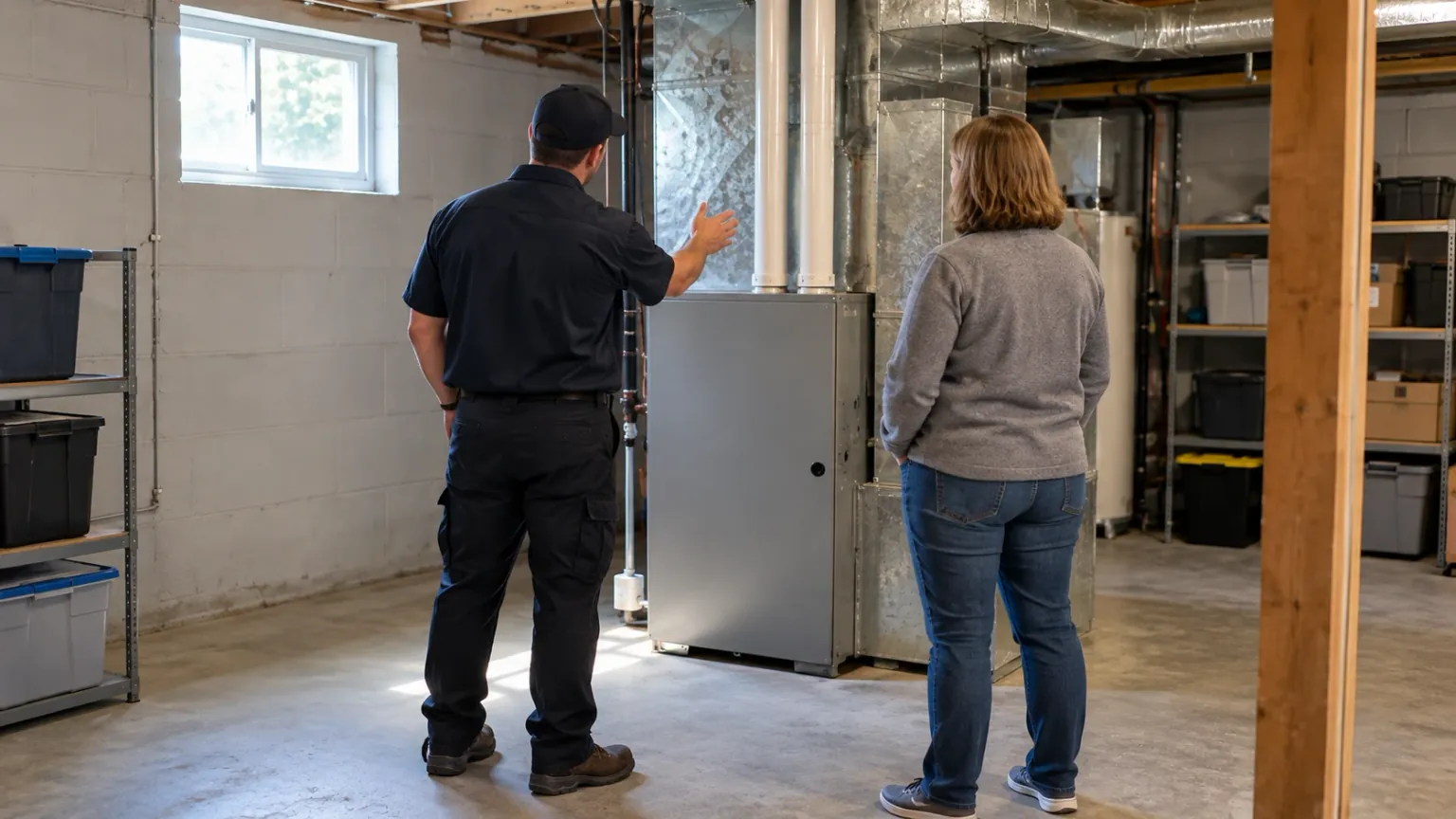
After the heat exchanger, the expensive repairs are the control board and a full blower motor replacement.
How much does a furnace service cost?
A maintenance visit and a repair visit are priced differently. A seasonal tune-up is a flat price and covers cleaning, inspection and testing. A repair is a diagnostic fee plus parts and labor. Some contractors credit the diagnostic against the work if you go ahead and some charge it separately, so ask which before you book.
Ask which one you're being quoted. People use the words loosely.
A tune-up usually covers the burners, the flame sensor, the ignitor, the blower, the filter, the flue, and a safety check for combustion and carbon monoxide. Where companies differ is how much of that list actually gets done instead of just written down. A thorough one takes the better part of an hour.
What a furnace tune-up covers goes through it in more detail.
What moves the price in Fort Wayne
Four things decide where in those ranges your quote lands: when you call, how easy the furnace is to get at, whether the part's already on the van, and whether the real problem is airflow instead of the part that failed. On a small repair an out of hours call can be a big share of the bill. On a big one the part dominates.
Here they are, one by one.
When you call. An evening, a weekend or a holiday costs more than a Tuesday morning. And the first hard freeze of the year is the busiest week in the trade. Emergency furnace repair is priced differently from scheduled work.
Access. A furnace in an open basement is quicker to work on than one wedged into a tight crawlspace or an attic. Same part either way.
Whether the part's on the van. Common parts are stocked. An older or less common furnace might need a part ordered, and that turns one visit into two.
Airflow problems. If the real cause is restricted airflow, replacing only the failed part means it'll just fail again. Ductwork and return air sizing are a bigger job. If someone raises it, ask what they measured, because that's the difference between a real finding and an upsell.
Questions people ask
What is the average cost of a new HVAC system in 2026?
A full system replacement, meaning furnace and air conditioner together, runs into several thousand dollars installed, and the spread is wide. Size, efficiency rating, the brand and whether the ductwork needs work all move it.
A furnace on its own costs a lot less than both together, but doing both at once is cheaper than two separate jobs a few years apart. Get at least three quotes, because this is the job where quotes differ the most.
How much does it cost to call an HVAC technician?
You'll pay a diagnostic or service call fee for the visit itself, whether or not you go ahead with the work. Some contractors credit it against the repair if you accept the quote and some don't, so ask about that when you book.
Outside normal hours, the fee's higher. It pays for the technician's time to find the cause, which on an on-and-off problem can take longer than the fix.
What time of year is the cheapest to replace HVAC?
Spring and early fall, in the gaps between heating and cooling season. Contractors are quieter then and lead times are shorter. The worst time to replace a furnace is a January cold snap, when you're choosing between whoever can come today and a cold house.
If your furnace is near the end of its life, replace it in the spring on your own schedule. It beats doing it in an emergency.
Is regular HVAC maintenance worth it?
For a gas furnace, yes, and mostly for two reasons that aren't about money. It gives someone a chance to find a cracked heat exchanger or a venting problem before it turns dangerous, and it keeps the airflow right, which is what shortens a furnace's life.
The Department of Energy puts the average life of a gas furnace at about 21.5 years, a modeling figure rather than a promise about any one furnace. Maintenance is part of what decides whether yours lands above or below it.
How much does it cost to repair an HVAC?
It depends entirely on which half. A furnace repair and an air conditioning repair are different jobs, with different parts and different prices. Anyone handling refrigerant also needs federal certification that a gas furnace repair doesn't require. What air conditioning repair costs here covers the cooling side.
Not sure which one failed? Describe the symptom when you ask for quotes, rather than guessing at the cause.
Does a higher efficiency furnace pay for itself?
Sometimes, but the math is slower than it sounds. Federal rules set the minimum at 80% AFUE for most new gas furnaces, and ENERGY STAR requires 97% or better in northern states like Indiana. A 2012 Department of Energy guideline puts the payback on going from a 78% furnace to a 90% one at around nine years, for a home spending $1,000 a year on heat. The install costs behind that are from 2010.
Planning to move in three years? Then the efficiency upgrade is really for the next owner.
Sources
- National cost guides published by three home services directories, checked October 2026
- US Department of Energy, energy conservation standards for consumer furnaces
- US Department of Energy, measure guideline on high efficiency natural gas furnaces
- ENERGY STAR key product criteria for furnaces
- Allen County Building Department, Rules and Regulations, 19th edition
Last updated